




Adults in malaria-heavy parts of coastal Kenya often stop getting sick after years of exposure. The parasite keeps circulating in their blood. Illness stops coming anyway.
A team in Kilifi deliberately gave 142 of those adults malaria under clinical conditions, then scanned their blood for what was keeping the protected ones safe. The answer was more specific – and more useful – than anyone expected.
Malaria vaccine issues

The licensed vaccine shots target the parasite at an early stage, right after a mosquito bite, before it reaches the liver. They cut severe cases in young children, but the protection wanes quickly.
Boosters are needed again and again in countries where clinics can sit hours away on foot. Doses get missed, immunity slips, and the cycle repeats.
Researchers have long known that something works better than any vaccine on the market. In places where mosquitoes carry the parasite year-round, many adults stop falling ill.
Their bodies still host the parasite, but the fevers and chills never arrive. The field calls this clinical immunity, and bottling it has been a goal for decades.
Malaria vaccine trial in Kilifi
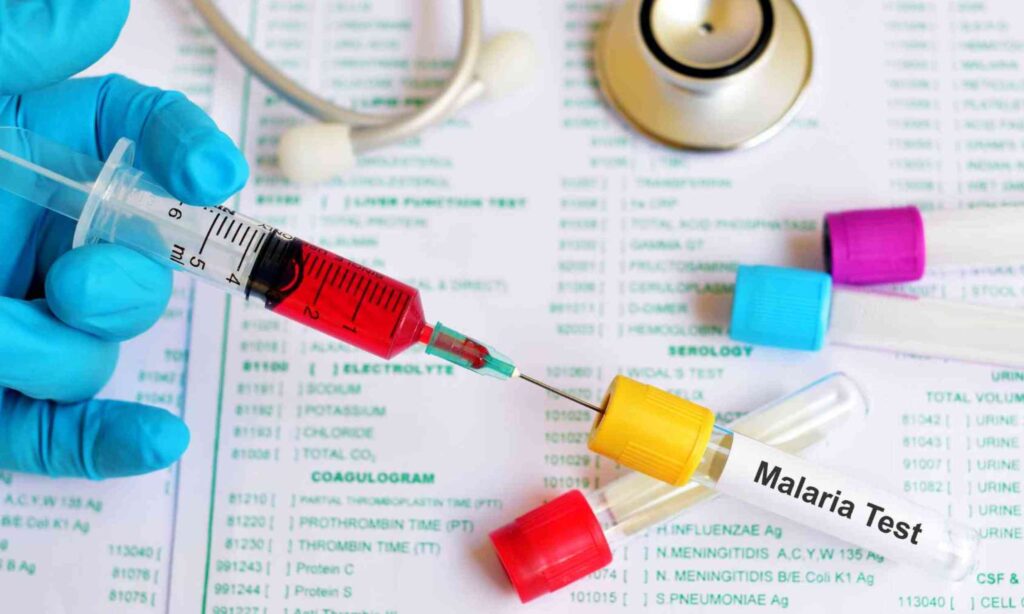
In Kilifi, Kenya, Dr. Rodney Ogwang of the Kenya Medical Research Institute-Wellcome Trust Research Programme (KEMRI-Wellcome), with colleagues at Imperial College London (Imperial), drew blood from 142 adult volunteers willing to be exposed to malaria parasites under medical supervision.
The trial gave each volunteer malaria on purpose, under close medical supervision, and tracked their immune responses as the infection took hold or did not.
Of the 142 volunteers, 86 cleared the infection without symptoms. The other 56 got sick. Fevers, parasites in their blood, the classic signs of malaria. That split handed the team a rare side-by-side comparison.
Some volunteers had grown up in the region and faced the parasite their whole lives. Others had not. The team needed to know whose immune systems were doing the work, and what specifically they were targeting.
Scanning seventy proteins
Plasmodium falciparum spends most of its life cycle inside red blood cells. To jump from one cell to the next, it briefly slips into the open as a merozoite – the short window when antibodies can actually reach it.
Researchers built a custom chip dotted with 70 merozoite proteins. They washed each volunteer’s blood sample across the chip and recorded which proteins the antibodies bound to, and how tightly. A scan of the immune signature inside every sample.
Patterns differed sharply between volunteers. Some samples produced strong signals across many proteins. Others flared up against just a handful.
The protected volunteers showed a distinct signature that researchers could spot in the data, even before running the statistics.
Six standouts emerged
Six names kept surfacing in the protected group: MSP1, MSP11, RAMA, MSP7, a protein known as PF3D7_1401600 or PHISTB, and PTEX150.
Antibodies against each were more common, and more abundant, in volunteers who cleared the infection.
MSP1 has been a vaccine candidate for years – earlier research put it in the spotlight. The other five were suspected players, but their association with protection in healthy adults had never been nailed down this clearly.
Power in combination
A single antibody was not enough. Volunteers with high levels of one protective antibody could still fall ill. But volunteers carrying antibodies against the full set of six? Those people were protected almost across the board.
That combination effect is the part of the paper the researchers keep returning to. Vaccines built around a single protein have a record of underperforming.
The parasite changes its surface proteins constantly. Hitting it from several angles at once seems to be what the immune system needs for protection to hold.
Five tests agree
To rule out a statistical fluke, the team ran the data through five different methods – two classical statistics tests, two machine learning models, and a regression model. All five flagged the same six proteins.
“These findings may be useful to prioritize the next generation of malaria blood stage vaccine candidates,” Ogwang and colleagues wrote. A consistent answer from five different angles is hard to wave off.
Limits of the data
The findings come from 142 adults in one part of coastal Kenya, and the trial infected volunteers on purpose rather than tracking people with lifelong natural exposure.
Whether the same six-protein pattern holds in different regions or in children – who carry the heaviest burden of this disease – has yet to be tested.
Where this goes
For decades, blood-stage malaria vaccines have stumbled in trials. One protein at a time. The results were thin, and the candidates rarely made it through.
This paper suggests a different approach: design a shot that triggers antibodies against several merozoite proteins at once, aiming for the kind of layered defense that protected adults already carry.
That could change which candidates get funded, which formulations move into phase one trials, and which combinations get tested in children. The current vaccines are not going away – they are still saving lives.
But their successors may not look much like them. Until this study, no one had shown which combination of antibodies matched the real-world protection seen in adults who simply stopped getting sick.
The study is published in Nature Communications.
—–
Like what you read? Subscribe to our newsletter for engaging articles, exclusive content, and the latest updates.
Check us out on EarthSnap, a free app brought to you by Eric Ralls and Earth.com.
—–