





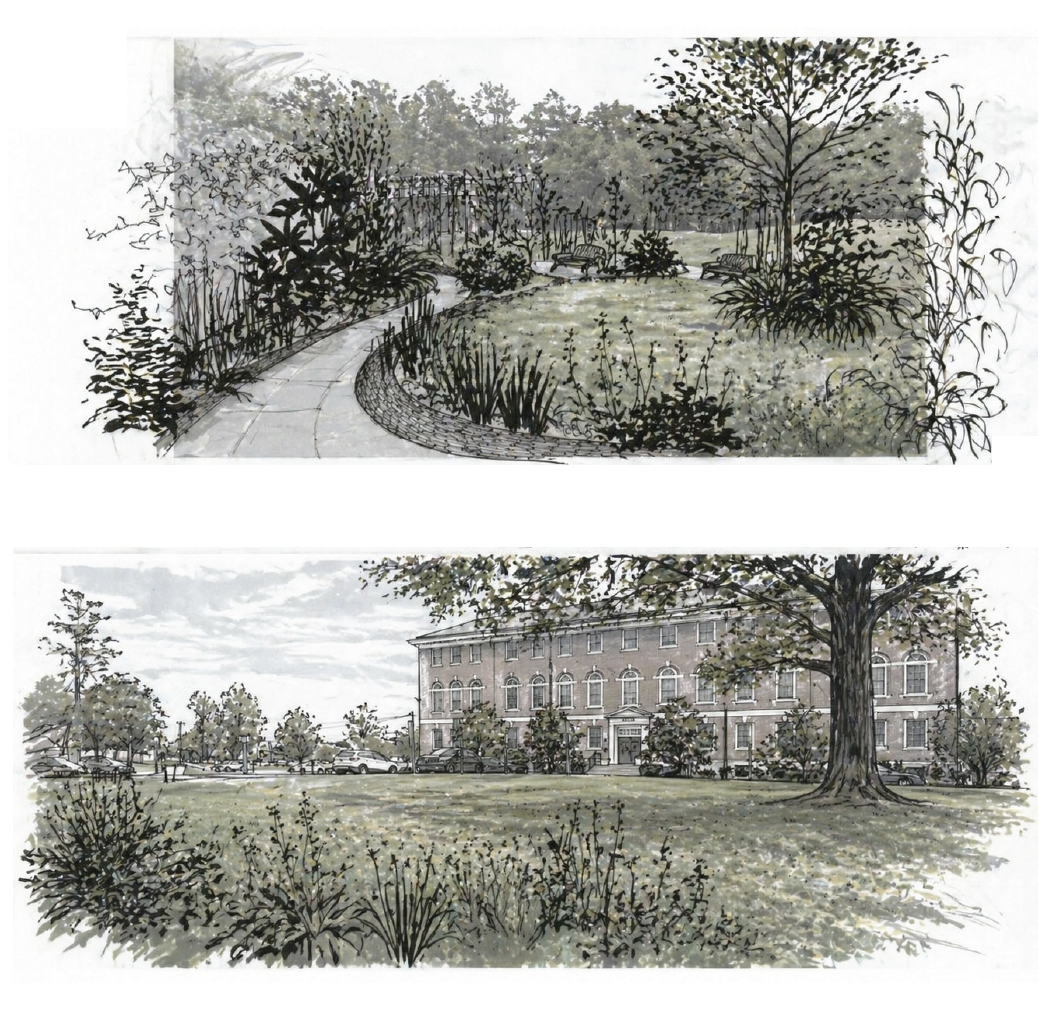
Site sketches.
What if a walk across campus could be as restorative as it is educational?
That question is inspiring a new vision for the Rutgers School of Environmental and Biological Sciences (SEBS), where faculty, students, and campus leaders are exploring how the grounds of the George H. Cook Campus might evolve into a Health and Wellness Arboretum—a living landscape that supports learning, research, environmental stewardship, and human well-being.
For generations, college campuses have served as shared spaces where students, faculty, and staff live, work, study, and connect. At SEBS, the campus already offers a rich mosaic of forests, farms, gardens, open spaces, and historic landscapes. The emerging Health and Wellness Arboretum concept asks a simple but transformative question: How might these landscapes be intentionally connected and enhanced to support the health of both people and the environment?
This spring, students in the Planting Design course taught by Holly Grace Nelson, professor of practice in the Department of Landscape Architecture, took on that challenge. Through a semester-long design exploration, students imagined the campus as more than a collection of labeled trees. Instead, they envisioned a network of themed “tree gardens” and health and wellness landscapes linked by an arboretum loop that would connect existing forests, trails, agricultural lands, gardens, and other campus features.
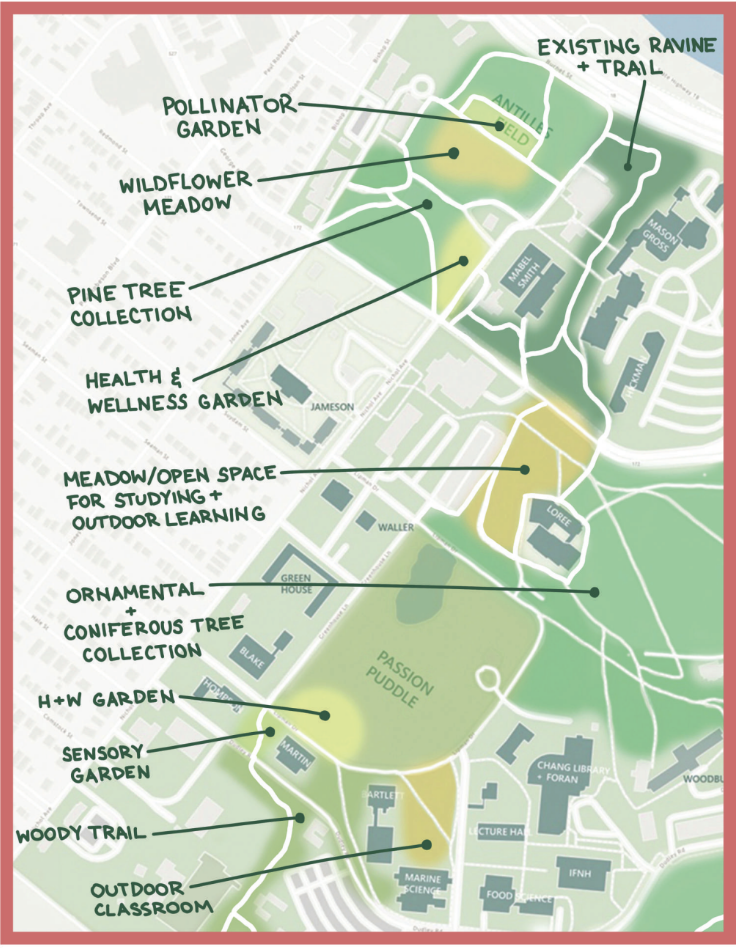 Their vision builds upon the traditional role of an arboretum as a living museum dedicated to the cultivation, study, and conservation of trees and woody plants. While arboreta have long served as centers for scientific research, education, biodiversity conservation, and recreation, the Health and Wellness Arboretum expands that mission by intentionally integrating human wellness into the landscape experience.
The project began with listening.
Students organized a design charrette that brought together faculty, staff, and students from across the campus community to discuss what makes outdoor spaces meaningful, welcoming, and restorative. The conversations generated ideas about accessibility, environmental education, quiet reflection, social connection, and opportunities for physical activity.
Jason Grabosky, professor in the Department of Ecology, Evolution, and Natural Resources, and director of the Rutgers Urban Forestry Program, shared his work documenting and geolocating significant campus trees. His insights highlighted the extraordinary diversity of the campus landscape and the ecological stories already embedded within its forests and tree collections.
Patty Oehmke, director of wellness at SEBS and professor of practice in the Department of Family and Community Health Sciences, encouraged students to think beyond traditional notions of health. Drawing on the eight dimensions of wellness, she challenged participants to consider how landscapes might support emotional, social, cultural, spiritual, intellectual, occupational, environmental, and physical well-being.
The resulting ideas ranged from contemplative garden spaces and outdoor classrooms to sensory plantings, wellness walking routes, interpretive signage, gathering spaces, and immersive nature experiences designed to encourage reflection, movement, and connection.
The initiative aligns closely with Rutgers’ broader commitment to sustainability and environmental leadership. Increasingly, colleges and universities are recognizing that campus landscapes can serve multiple purposes simultaneously—as classrooms, research sites, biodiversity refuges, community gathering spaces, and places that contribute to mental and physical health.
A Health and Wellness Arboretum also reflects the growing understanding that human health is deeply connected to environmental health. Exposure to nature has been associated with reduced stress, improved mood, enhanced cognitive function, and increased opportunities for physical activity. By weaving these principles into the design and management of campus landscapes, institutions can create environments that actively support learning and well-being.
The concept continues to gain momentum this summer as landscape architecture junior Saanvi Bhattarai further develops some of the most promising ideas through the Public Design Internship Program in Landscape Architecture, funded through a grant secured by Nelson. Based in Rutgers Institutional Planning and Operations, Bhattarai is working with Brian Clemson, University Landscape Architect, to explore how student-generated concepts might inform future campus planning efforts. Co-directed by Clemson and Nelson, the internship provides an opportunity to advance the Health and Wellness Arboretum vision beyond the classroom, connecting academic design exploration with real-world campus planning and landscape stewardship.
For Nelson, the initiative represents an opportunity to connect the strengths of SEBS—its expertise in environmental science, agriculture, ecology, design, and human well-being—into a unified vision for the future.
“A Health and Wellness Arboretum ties together our campus grounds with our campus mission for a healthy and sustainable future,” Nelson said. “It invites us to think about how every landscape can support learning, stewardship, community, and wellness while reinforcing our responsibility to balance the wellbeing of all living organisms with the health of the earth.”
As the concept evolves, the Health and Wellness Arboretum offers a compelling vision for what a modern land-grant campus can be: a living laboratory, a place of discovery, and a landscape designed not only to educate, but also to nurture.