





The second edition of the “Go Healthy with Taiwan” global proposal campaign, launched May 27 and open for applications until Aug. 5, is a government-backed initiative inviting organizations worldwide to co-develop health and wellness solutions incorporating Taiwanese products, technology, and business models. Each of the three top-ranked teams will receive $30,000. But the prize money is not the point.
Taiwan’s three-pillar focus: fitness and sports tech, cycling, and smart healthcare
Commissioned by Taiwan’s International Trade Administration (TITA), Ministry of Economic Affairs, and executed by the Taiwan External Trade Development Council (TAITRA), the inaugural 2025 edition focused on three areas where Taiwan holds established industrial leadership: fitness and sports technology, cycling, and smart healthcare.
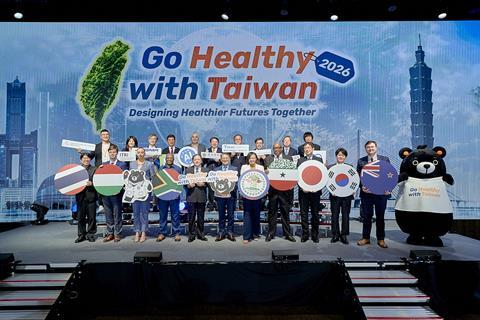
The 2025 campaign generated 638 proposals from 55 countries. The 2026 edition is targeting more than 800 proposals from five continents.
Why fitness and cycling, and why now
The Taiwanese government is promoting a “Taiwan Sports x Technology Action Plan” running from 2022 to 2026, which aims to build smart venues, integrate fitness equipment with digital technology, and establish an industrial ecosystem around sports data. The initiative targets industry output of approximately $30 billion by 2026 and $39 billion by 2030.
In cycling, Taiwan’s position is structural.
Taiwan supplies roughly 65–70% of global mid-to-high-end bicycles. The cluster includes not just frame manufacturers but an interlocking supply chain of components, electronics, and materials: most of it is concentrated in and around Taichung. Yet the market is under pressure: Taiwan’s bicycle exports fell below one million units in a recent year, dropping 31 percent compared to 2023, and e-bike exports fell 47 percent, amid inventory overhangs and weak demand.
The “Go Healthy” campaign, by folding cycling into a health-and-wellness narrative, is partially an attempt to re-energize export demand.
In fitness equipment, Johnson Health Tech, headquartered in Taichung, founded in 1975, provides a benchmark for the industry’s ambition. As of end-2025, the company reported trailing 12-month revenue of $1.74 billion. In 2024, Johnson acquired home fitness brands BowFlex, Schwinn Fitness, and JRNY, expanding its consumer business globally. Taiwan’s overall exports grew 17.5% YoY in Q1 2025.
The diplomatic dimension
Taiwan faces the challenge of limited international participation and a lack of formal government-to-government channels through which it can communicate its interests. Despite China’s efforts to diplomatically isolate Taiwan, and the fact itself that Taiwan has a limited degree of formal diplomatic recognition as a sovereign state, the island remains an important economic and technological partner for many countries.
Unconventional diplomatic strategies have become central to its approach.
Taiwan’s approach to soft power became most visible during the COVID-19 pandemic, when it redirected production to ship over 54 million masks to more than 80 countries. That gesture reinforced the idea of Taiwan as a responsible international actor, even as it was excluded from the World Health Organization.
The health and wellness sector is a natural extension of that logic.
It is politically neutral, commercially substantive, and capable of creating bilateral dependencies that outlast any single transaction. The 2026 campaign is designed to generate what organizers describe as “demonstrative and multiplier effects,” positioning Taiwan as the preferred global partner for health solutions.
Selection criteria weight connection to Taiwanese enterprises and feasibility equally with health impact and innovation, at 25 percent each.
Taiwan’s economic diplomacy runs on parallel tracks: opening a Taiwan Trade and Investment Service Center in Warsaw, establishing a joint semiconductor laboratory with Slovakia, and promoting “democratic supply chain partnership” in Europe. Together, these efforts multiply points of commercial dependency before formal diplomatic recognition becomes an issue.
What this means for European brands and retailers
For European brands and retailers, the campaign represents a structured entry point into Taiwan’s manufacturing and technology ecosystem: one that comes with government facilitation, prize incentives, and trade show exposure.
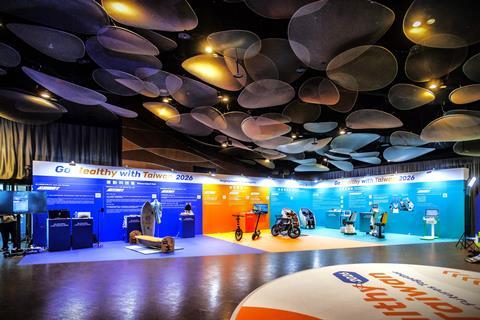
The president and CEO of TAITRA, Simon Wang, confirmed that the 2026 campaign will be paired with a series of international trade shows and business-opportunity events to bring Taiwan’s capabilities in cycling, sports technology, and smart healthcare to global buyers. One confirmed activation: the Taiwan Expo in Poland this June, where the top three winners from the 2025 edition will present their collaboration experience.
For brands assessing sourcing diversification, for retailers evaluating connected fitness partnerships, and for investors watching where the next wave of sports tech investment originates, Taiwan’s campaign provides a concrete intelligence signal. The island is not waiting for geopolitics to stabilize before expanding its commercial relationships.
TITA — the International Trade Administration, Taiwan’s Ministry of Economic Affairs — is the government body responsible for trade policy and international commercial relations. TAITRA (Taiwan External Trade Development Council) is Taiwan’s leading trade promotion organization, operational since 1970.
The “Go Healthy with Taiwan 2026” proposal window is open until Aug. 5, 2026. Full details and form to submit proposals here: gohealthy.taiwanexcellence.org
The Taiwan Expo in Europe will take place in Warsaw from June 22–24, 2026. For more info: www.taiwanexpoeurope.com