




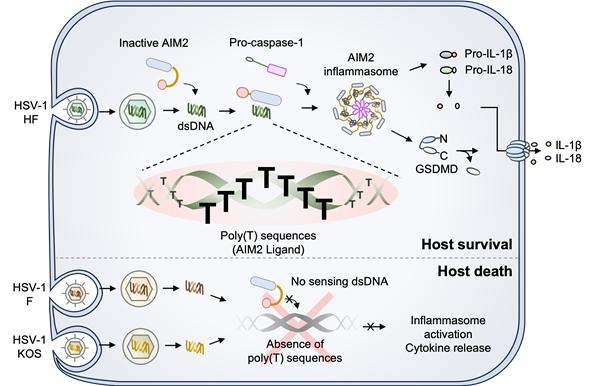
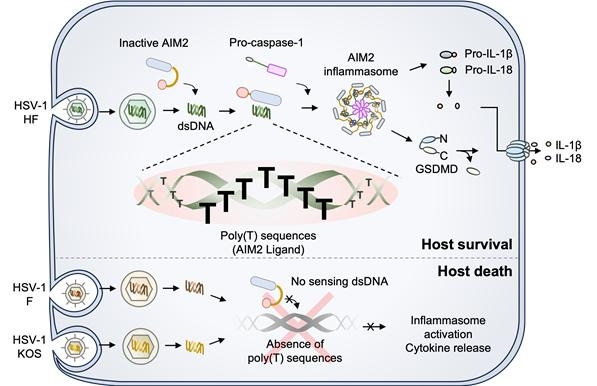
 How the host immune sensor recognizes viral DNA. Image: UNIST
Korean researchers have identified the core mechanism by which the body’s immune system precisely detects and attacks the herpes virus.
A research team led by Professor Lee Sang-joon of the Department of Biological Sciences at the Ulsan National Institute of Science and Technology (UNIST) announced Thursday that it has discovered how the innate immune sensor “AIM2” recognizes specific repeat sequences in herpes virus DNA to trigger an immune response. The research was conducted jointly with Sungkyunkwan University, Jeju National University, and the Center for Viral Immunology at the Institute for Basic Science (IBS).
Herpes simplex virus type 1 is a common virus that infects approximately 67 percent of the global population. It typically evades immune surveillance by lying dormant in nerve ganglia, but when immunity weakens, it infects the host’s skin cells and causes inflammation around the lips. This inflammation is a defensive response to eliminate infected cells, and AIM2, a protein found in macrophages, serves as the sensor that detects the virus.
The research team found that AIM2 operates by detecting “poly(T)” regions, stretches where thymine (T) base molecules repeat in long sequences, within the viral DNA structure. Even among strains of the same herpes simplex virus type 1, AIM2 was activated only when poly(T) sequences were present in the strain’s DNA, inducing inflammatory responses and the death of infected cells.
In contrast, strains lacking the sequence or containing only short stretches with fewer than 20 thymine bases showed almost no immune response. When the sequence was injected into other strains, an immune response was newly induced, and a “length dependency” was also confirmed, with stronger responses observed as the repeat sequence grew longer.
Animal experiments supported these findings. Mice infected with a virus carrying the poly(T) repeat sequence suppressed viral replication through inflammatory responses, while mice infected with a virus from which the sequence had been removed showed no immune response, allowing the virus to proliferate rapidly and reach a fatal state.
Furthermore, through extensive genomic data analysis, the team discovered that this poly(T) repeat sequence is broadly conserved not only in herpes but also across various infectious virus groups, including mpox virus, adenovirus, and coronavirus.
“We have newly revealed that the human immune sensor recognizes viruses far more precisely than previously thought,” Professor Lee said. “Therapies that regulate the activity of immune sensors, rather than directly attacking the virus itself, are drawing attention as a new alternative, and this discovery will serve as the theoretical foundation for developing such customized immune-modulating drugs.”
Lee added, “Because the repeat sequence identified in this study is commonly conserved in various infectious viruses that cause severe diseases beyond herpes, further investigation into the correlation between actual patients’ disease severity and viral genome sequences will help design treatment strategies for various infectious diseases.”
The research was conducted as a convergence study with Professor Lee Joo-sang of Sungkyunkwan University, Professor Kim Eui-tae of Jeju National University, and the team led by Director Choi Young-ki of the IBS Center for Viral Immunology. The findings were published online on April 13 in the internationally renowned journal Nature Communications.
The research was supported by the National Research Foundation of Korea (NRF) Outstanding Young Researcher Program, the Korea Drug Development Fund (KDDF), the Global Physician-Scientist Training Program of the Korea Health Industry Development Institute (KHIDI) under the Ministry of Health and Welfare, the Korean ARPA-H Project, the Animal and Plant Quarantine Technology Development Program, the Institute for Basic Science (IBS), the Korea National Institute of Health under the Korea Disease Control and Prevention Agency, the Dongkwa Foundation, and Yuhan Corporation.